If some radiators in your home heat up quickly while others stay stubbornly cool, your system probably needs balancing. Balancing radiators means adjusting the valves so every radiator gets the right amount of hot water at the right time. When you balance your radiators properly, all rooms heat more evenly, your boiler works more efficiently and you avoid wasting energy and money on overheating just a few radiators.
Read time:
9 mins
Table of contents:
•
What is balancing a radiator?
Radiator balancing or hydronic balancing is the process of adjusting the flow of hot water through each radiator so they all heat up at roughly the same speed. In a typical central heating system, water from the boiler flows through a circuit of pipes and radiators. Radiators closer to the boiler or on upper floors often get more hot water first, while those further away may receive less and warm up more slowly.
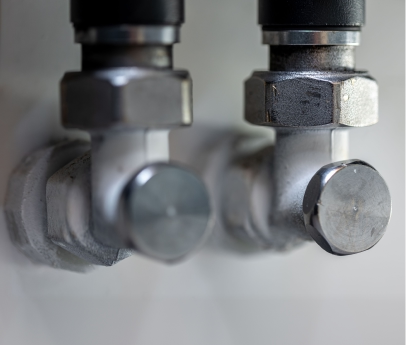
Balancing is done mainly using the lockshield valves on each radiator. By partly closing the lockshield on radiators that heat up quickly and opening it more on slower radiators, you can even out the flow. If a radiator has cold spots only at the top, that usually indicates trapped air and you should bleed it first; if it is cold at the bottom, sludge may be the issue and the system may need flushing. For bleeding, you can follow our separate guide on how to bleed a radiator.
When and how to balance radiators
You should balance your radiators when some rooms heat up much faster than others even though your boiler and thermostat settings are correct. Balancing is done by opening the valves on cooler radiators a bit more and slightly closing the lockshield valves on hotter radiators until they all warm up at a similar rate. If you have tado° Smart Radiator Thermostats, you can easily see which rooms regularly lag behind their target temperature in the app and use that as a guide for which radiators may need balancing.
If you've noticed that some radiators take much longer to heat up than others, they probably need to be balanced. If your radiators are not evenly balanced, they will not warm up quickly. For instance, if the radiators in the bedroom warm up rapidly while the living room takes a long time to warm up, your radiators require balancing. Balancing entails adjusting radiator valves to ensure that hot water is distributed evenly to all radiators. Don't panic. It's a clear and straightforward DIY task. Moreover, in this post on how to balance radiators, we'll provide you with the details to get your radiators operating again.
If you live in a flat or apartment building with a shared central heating system, balancing is typically managed by the building management. Contact your landlord or property manager if you suspect the system needs attention.
Why balancing radiators matters
Radiators need occasional maintenance to work at their best. You may not notice anything at first, but over time an unbalanced system can leave some rooms too hot and others uncomfortably cold. In many homes, especially multi‑storey houses, radiators close to the boiler or on upper floors get most of the hot water, while radiators further away struggle to heat properly.
When radiators are balanced, heat is distributed more evenly across the system. This means your boiler does not have to work as hard or run as long just to bring cold rooms up to temperature, which can help reduce your heating bills. A properly balanced system can support better comfort, fewer cold spots and lower energy use, especially when combined with good insulation and smart heating controls like tado°.
Benefits of balanced radiators:
Heat spreads evenly across all rooms
Boiler runs more efficiently
Heating bills reduce
Comfort improves in every room
System strain decreases
Now that you understand why balancing matters, let's look at the technical process behind it.
Things to know before you balance radiators
Balancing radiators takes some time and patience, but the actual adjustments are simple. Most of the time is spent waiting for the system to heat up or cool down between steps. The actual balancing work takes just a few minutes per radiator, but allow a full day to complete the process for a typical home because of the cooling and heating cycles.
Note for homeowners: There are two approaches to balancing radiators – a simplified DIY method (covered in this guide) and a full professional balance with heat loss calculations. For most homes, the DIY method delivers noticeable improvements without the need for a professional.
Tools you need
Before you start, gather a few tools:
Radiator bleed key: Remove trapped air first
Digital thermometer: For accurate temperature readings
Adjustable spanner or lockshield key: To adjust lockshield valves
Pen and paper: Record radiator heating order
Get familiar with your radiator valves
Radiators, including more traditional radiators, usually have at least two valves. Before you begin, identify which valve is the lockshield on each radiator and remove any protective caps so you can access them.
Wheel-head valve or TRV (thermostatic radiator valve):
Controls room temperature
Usually has numbers or temperature marks
You adjust this for day-to-day comfort
Lockshield valve:
Usually has a plain cap
Adjusted with a spanner or key
Controls water flow rate
This is what you adjust when balancing
What if I don’t have a lockshield key?
Many lockshield valves can be adjusted with a small adjustable spanner or a dedicated lockshield tool rather than a classic ‘radiator key’ used for bleeding. If your lockshield valve has a removable plastic cap, take it off and check whether the metal spindle underneath can be turned with a spanner. If you are unsure or the valve design is unusual, it is safer to ask a heating professional rather than force it and risk a leak.
How to balance a radiator (with a thermometer)
Follow these steps carefully for each radiator that needs balancing.
Step 1: Turn off the heating and let radiators cool
Switch off your central heating and wait until all radiators are completely cool. This gives you a clear starting point and makes it easier to see how quickly each radiator heats up later. If you have recently bled your radiators, your temperature readings during balancing are likely to be more accurate because there is less trapped air in the system.
Step 2: Open all radiator valves fully
Go to each radiator in your home and:
Turn the TRV fully anti-clockwise (open)
Remove the lockshield cap
Turn the lockshield fully anti-clockwise (open)
Use your spanner or key
This ensures every radiator has maximum flow before you start measuring how quickly they heat up.
Step 3: Turn the heating on and note the order radiators heat up
Switch your heating back on and set the thermostat to a higher temperature so the boiler runs continuously for a while. Walk through your home and note the order in which radiators start to get hot. Radiators closest to the boiler will usually heat up first. Write down the sequence or give each radiator a number in the order it warms up, from fastest to slowest. This list is important for the next steps.
Step 4: Turn the heating off and let the system cool again
Once you have recorded the heating order, switch the heating off again and wait for the system to cool down. This can take some time and may be easier if you leave it to cool for an hour or more, or even overnight.
Step 5: Restart the heating and adjust the fastest radiator
Turn your heating back on and return to the radiator that heated up first in your list. This is usually the radiator receiving the most flow and the one you adjust first.
Close the lockshield valve on this radiator completely by turning it clockwise.
Then open it again by a small amount, for example a quarter turn.
When the radiator heats up, use your digital thermometer to measure the temperature of the pipework near the inlet valve and near the outlet (lockshield) valve. Adjust the lockshield slightly until the difference between the two readings is around 12°C. Make small adjustments and wait a few minutes after each change so temperatures stabilise.
Step 6: Balance the remaining radiators in order
Move on to the next radiator in your list (the second‑fastest to heat up) and repeat the process:
Ensure its TRV is fully open
Start with lockshield partly closed
Adjust gradually while radiator warms
Measure inlet and outlet temperatures
Aim for approximately 12°C difference
Continue in the same way for each radiator, following the order in which they originally heated up. As you work through the system, radiators that used to be slow should start to heat more quickly because the earlier radiators have been throttled slightly.
Step 7: Check that all radiators heat evenly
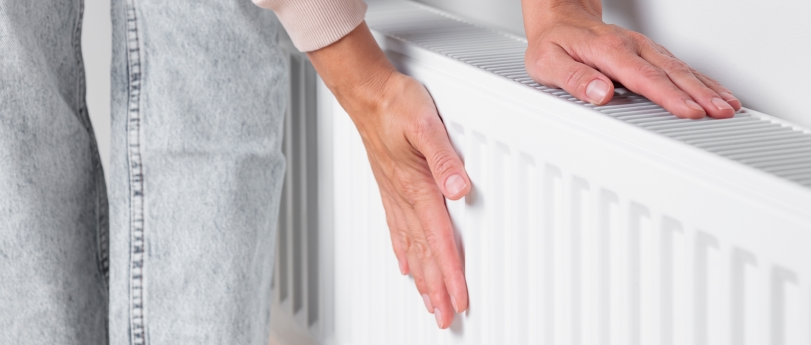
Once you have adjusted all radiators, let the heating run for 30 minutes to an hour. Then walk through your home and feel each radiator from top to bottom. All radiators should now be heating at a similar rate and feel reasonably even in temperature.
If one radiator is still noticeably cooler than the others, you can open its lockshield slightly more and recheck after a few minutes. If a radiator remains stubbornly cold at the top, bleed it again; if it is cold at the bottom, sludge may be present and a professional system flush could be needed.
How to balance radiators without a thermometer
If you do not have a digital thermometer, you can still balance radiators by feel. This method is less precise but can give good practical results.
Bleed all radiators first. Remove trapped air. You're working with water only.
Open all TRVs and lockshields fully. Turn heating on. Let system run until all radiators are hot.
Identify the hottest radiators. Feel pipes and radiator surfaces carefully. Be cautious – they can be very hot. Usually radiators closest to the boiler or upstairs.
Partially close lockshields on hot radiators. Turn clockwise a quarter turn. Leave cooler radiators fully open.
Wait 10–15 minutes. Let system settle. Feel all radiators again.
Repeat in small steps. Slightly close lockshields on radiators that still feel hotter. Leave cooler ones open. Continue until all radiators feel more similar.
Take your time and make small changes. The goal is not to make every radiator exactly the same temperature at every point, but to avoid having a few radiators that are very hot while others remain lukewarm.
How to balance a central heating system
Balancing individual radiators also helps to balance your whole central heating system. The aim is to achieve a suitable flow rate through each radiator so your home reaches a comfortable temperature without running the boiler longer than necessary.
If the overall flow is too fast, water may pass through radiators without transferring enough heat into the rooms, leaving them colder than expected. If the flow is too slow, the system may take a very long time to warm up. By adjusting lockshield valves in a controlled way across your radiators, you guide hot water to where it is needed most and prevent radiators nearer the boiler from dominating the flow.
In some homes, a professional may also adjust the circulation pump speed or use automatic balancing valves to fine‑tune the system. For most DIY balancing, however, the steps above are sufficient to improve comfort and reduce wasted energy.
How to know if you should balance your radiators
If some radiators are hot while others in the same system are much cooler or heat up later, your system may be unbalanced. In a balanced system, radiators in different rooms should warm up at similar speeds. If radiators closer to the boiler are always much hotter than those further away, it is a strong sign that balancing would help.
What is the difference between bleeding and balancing a radiator?
Both balancing and bleeding improve radiator performance. But they solve different problems.
When to balance your radiators
Balancing addresses uneven water distribution. Not trapped air.
You should consider balancing your radiators if:
Some radiators heat quickly while others lag far behind
Certain rooms (like upstairs bedrooms or rooms near the boiler) become very warm while others stay cool
Your system has been drained, flushed, extended, or had multiple valve adjustments
Multiple valves have been changed or adjusted over time
Why radiators become unbalanced
Several factors can cause your system to become unbalanced over time:
Sludge and debris: Older systems accumulate corrosion deposits. These partially block some radiators or pipes.
Renovation work: Removing and refitting radiators during decorating changes valve settings. The original balance is lost.
Incorrect valve use: TRVs or lockshields adjusted incorrectly disrupt balance.
When to bleed your radiators
Radiators need bleeding if they have trapped air. Typical signs include:
Radiator top feels cooler than bottom when heating is on
Gurgling or bubbling noises inside radiators
Radiators never reach target temperature despite correct thermostat settings
Bleeding releases air so hot water can fill the whole radiator. It is a different process from balancing, but both may be needed for an older or recently serviced system.
tado° Hydronic Balancing
The manual method above works – but it takes time and patience. tado° offers an automated Hydronic Balancing feature that does the job continuously and without any plumbing work. This AI-powered feature digitizes the complex task of balancing radiators, making it accessible to everyone. By utilizing tado° X Smart Radiator Thermostats, the system automatically manages water flow to ensure even heat distribution. The feature is included in the AI Assist subscription.
Balancing radiators as part of a simple maintenance routine
If you balance your radiators after major changes to the system and whenever you notice some rooms heating much faster than others, you can usually keep your heating running smoothly. Combined with occasional bleeding and a quick boiler pressure check, balancing becomes a straightforward maintenance habit rather than a complicated job.
Over time, a balanced system helps radiators heat more evenly, reduces strain on your boiler and can support lower energy bills, especially when paired with smart controls like tado°. Check regularly whether your radiators are warming up at around the same time. If not, re-balance.
FAQs
How often should I balance my radiators?
Most homes only need a full radiator balance after major changes to the heating system, such as adding or removing radiators, flushing the system or replacing the boiler. If you notice that some rooms are consistently much warmer or cooler than others, or radiators heat up at very different speeds, it is a good time to balance them again.
Will balancing radiators save money on my energy bills?
Balancing radiators helps your boiler heat your home more evenly and efficiently. When all radiators receive the right amount of hot water, the boiler does not have to run as long just to bring cold rooms up to temperature, which can reduce wasted energy. Combined with smart controls like tado° and good insulation, a balanced system can support lower heating bills over time.
Should I bleed or balance my radiators first?
If radiators have cold tops or make gurgling noises, you should bleed them first to remove trapped air. Once all radiators are full of water and free of air, you can balance them so they heat up at a similar rate. Bleeding and balancing solve different problems, and many older systems benefit from doing both.
Does hydronic balancing only work with heat pumps?
No. Hydronic balancing is a general term for balancing any wet central heating system with radiators. The manual DIY method described in this guide works with: