A heat pump is a heating system that draws energy from the environment around it. Through a thermodynamic cycle – evaporating, compressing, condensing, and expanding a refrigerant – it converts natural heat from the air, ground, or water into usable warmth for your home. An efficient system typically generates three to four kilowatt-hours of heat for every single kilowatt-hour of electricity it consumes. That makes it one of the most energy-efficient and sustainable heating technologies available today.
Tiempo de lectura:
10 mins
Tabla de contenido:
•
What exactly is a heat pump?
A heat pump is a heating system that uses thermal energy from its surroundings to warm your home. That energy can come from the air outside, the ground beneath your feet, or groundwater underground.
Unlike a gas boiler or oil burner, it doesn't burn fuel. Instead, it uses a physical process to "pump" existing heat energy from one place to another. It moves that heat from a colder place – the outside environment – to a warmer one: your home.
That might sound paradoxical at first. Doesn't heat always flow from warm to cold? That's precisely where the engineering brilliance of the heat pump comes in. It overcomes that natural tendency using a clever thermodynamic cycle.
How is a heat pump system made up?
A heat pump heating system has three core components:
Heat source system: Draws energy from the environment.
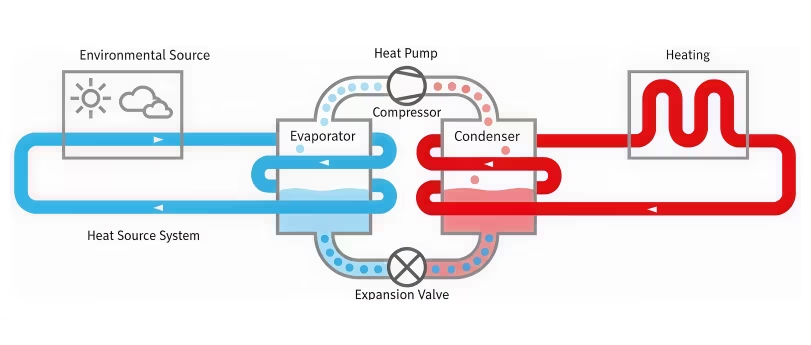
The heat pump itself: Makes that captured energy usable. The heat pump itsel consists of four components: evaporator, compressor, condenser and expansion valve. A refrigerant circulates in the refrigeration cycle.
Heat distribution and storage system: Distributes warmth throughout your home.
How exactly does a heat pump work?
The operating principle of a heat pump is based on compression: when a gaseous refrigerant is strongly compressed, its temperature rises dramatically. The system extracts thermal energy from the environment (air, ground, or water), raises it to a usable temperature level using an electric compressor, then releases it into your heating system. In this way, heat is efficiently moved against its natural direction – from outside to inside.
Like a fridge in reverse
The fridge comparison is probably the most popular way to explain how a heat pump works – and for good reason. A fridge operates on exactly the same principle. As the Energy Saving Trust explains, a heat pump uses the same refrigeration cycle as a fridge, just running in the opposite direction. Your fridge continuously removes heat from its interior and releases it through the grille at the back – warming your kitchen slightly in the process. That's why it's always a little warmer behind the fridge.
A heat pump does exactly the opposite: it extracts heat from the outdoor air, the ground, or groundwater, then transfers that heat into your heating system. What's remarkable is that this works even when it's below freezing outside. That's right – heat pumps work in sub-zero temperatures, because even cold air contains thermal energy. The only absolute limit is −273.15 °C (absolute zero), which – fortunetly – is quite unlikely.
How a heat pump works, step by step
Source: Adapted from Verbraucherzentrale NRW
Step 1 – Evaporation: Heat is absorbed from the environment
The liquid refrigerant flows through a network of pipes in contact with the heat source (air, ground, or groundwater). The refrigerant starts at a very low temperature – significantly lower than the air or ground around it. That temperature difference is enough to cause heat to transfer from the environment into the refrigerant. As it absorbs this heat, the refrigerant evaporates and changes from a liquid into a gas.
Step 2 – Compression: Temperature is raised through pressure
The gaseous refrigerant then flows into the compressor. This compresses the refrigerant to a much higher pressure, which causes its temperature to rise sharply. After compression, the refrigerant is hot enough to warm the water in your heating system.
Step 3 – Condensation: Heat is released into your heating system
The hot, pressurised refrigerant enters the condenser. Here, it transfers its heat into the heating water, which is at a lower temperature. Heat flows naturally from the hot refrigerant into the cooler water. As it cools, the gaseous refrigerant condenses back into a liquid. The heat it has released is now available to warm your home.
Step 4 – Expansion: Pressure is released at the expansion valve
The refrigerant, now liquid again, is still under high pressure. Before the cycle can begin again, that pressure must be relieved. This happens at the expansion valve. As the refrigerant passes through a narrow opening into a lower-pressure zone, it cools rapidly. It's now back to its original temperature – ready to absorb environmental heat again. The cycle starts afresh.
Component
Function
Refrigerant state
Energy transfer
Evaporator
Absorbs heat from the environment (air, ground, water)
Liquid → Gas (boiling at low temperature)
Input: thermal energy from the environment
Compressor
Raises temperature through mechanical pressure
Gas (becomes very hot and highly pressurised)
Input: electrical energy
Condenser
Releases the concentrated heat into the home
Gas → Liquid (condensation)
Output: heating warmth for radiators/water
Expansion valve
Rapidly relieves pressure
Liquid (cools sharply through expansion)
Process: prepares refrigerant to absorb heat again
Source: Adapted from Energy Saving Trust
Why are heat pumps so efficient?
Here lies the truly fascinating thing about a heat pump: it doesn't generate heat – it transports it. The electricity it uses doesn't power the heating itself; it powers the compressor that drives the whole process. Because heat is moved rather than generated, the system delivers far more energy than it consumes. As the Energy Saving Trust explains, for every unit of electricity used, a heat pump can produce three to four units of heat in return – something no conventional boiler can match.
The COP: putting efficiency into numbers
The efficiency of a heat pump is measured by its Coefficient of Performance, or COP. As the Energy Saving Trust explains, this figure tells you how many units of heat the system produces for every unit of electricity it uses. Modern air-to-water heat pumps typically achieve a COP of around 3 to 4. That means 1 kWh of electricity produces 3 to 4 kWh of heat.
What affects heat pump efficiency?
Temperature difference: The smaller the gap between the heat source temperature and the required heating water temperature, the more efficiently the heat pump operates.
Flow temperature: Heat pumps work most efficiently at lower flow temperatures. Underfloor heating is well suited to heat pumps for exactly this reason.
Heat source: Different sources deliver different levels of consistency. Outdoor air temperature fluctuates significantly, whereas the temperature of the ground and groundwater stays relatively stable year-round. Ground source and water source heat pumps therefore tend to perform more consistently in very cold weather.
System calibration: A well-configured heat pump performs better than a poorly set-up one. Factors like the heating curve, cycling behaviour, and hot water settings all play a role.
Heat pumps are primarily distinguished by their heat source. The naming convention follows a simple pattern: the first term refers to the heat source, the second to the medium that delivers the heat.
There are four main types:
Heat pump type
Heat source
Key characteristics
Air-to-water heat pump
Outdoor air
Cost-effective, no groundworks required; efficiency drops at very low outdoor temperatures
Ground source heat pump
Ground
Highly efficient thanks to stable soil temperatures; collectors (1.2–1.5 m depth) or boreholes (up to 100 m); planning permission may be required
Split-unit system; no separate wet heating system needed; no planning permission required; can also cool; cannot heat domestic hot water
Each type has its advantages and trade-offs. The right choice depends on your property, your budget, and what you need from your system.
Smart control: getting the best from your heat pump
A heat pump is a significant investment in your home. The Heat Pump Optimizer X helps you get the most out of it. Save an average of 22 %¹ in energy – without sacrificing a degree of comfort.
More efficiency, fewer worries
The Heat Pump Optimizer X reduces your running costs and lowers your carbon footprint. Increase your heating efficiency by 22 %¹ on average. That saves money and up to 251 kg of CO₂ every year2.
Intelligent control via the app
Full control, wherever you are. Manage your rooms and hot water easily with the tado° app. Set up Smart Schedules for every room that fit around your day.
Easy self-installation
No engineer required. The tado° App guides you through installation step by step, tailored precisely to your system.
Maximum savings with tado° Balance
Your heat pump uses electricity when it costs the least. Combined with a tado° Balance subscription, the system automatically shifts heating to times of lower energy prices or higher solar generation.
AQUAREA Sync & Hydronic Balancing
As an exclusive Panasonic partner, tado° offers the new AQUAREA Sync feature. It prevents excessive cycling and extends the life of your heat pump. Together with Hydronic Balancing, tado° ensures every room receives exactly the warmth it needs.
¹ Based on internal tado° data from average values across all tado° users, collected up to 30.11.23.
2Actual savings depend on household energy use and regional factors. CO₂ savings are based on 20,000 kWh average heating demand, a heat pump efficiency (COP) of 3.5, and an EU electricity emission factor of 0.20 kg CO₂/kWh, resulting in estimated savings of up to 251 kg CO₂ annually for a 22% energy reduction. Data sourced from the European Commission’s REPowerEU plan 2023 and European Heat Pump Association reports. Individual results may var
FAQs
Does a heat pump work in freezing temperatures?
Yes, absolutely. Even at −20 °C, outdoor air still contains usable thermal energy. Modern air-to-water heat pumps operate reliably well below freezing. Efficiency does fall at very low temperatures – the compressor has to work harder to bridge the larger temperature gap. Ground source and water source heat pumps are largely unaffected, as their heat source maintains a stable temperature year-round.
How noisy is a heat pump?
It varies by type and model. Ground source and water source heat pumps are virtually silent, as they don't rely on large fans. Air-to-water heat pumps do produce some noise, which some people may find noticeable. Acoustic screening can help. Many modern models include a quiet or night mode.
Can a heat pump also cool my home?
Some heat pumps can be used for cooling in summer. There are two modes: passive cooling and active cooling. Cooling capacity is limited – a heat pump won't replace a full air conditioning system – but it can make a real difference on hot days.
How long does a heat pump last?
Heat pumps are long-lived systems. You can typically expect a lifespan of 15 to 25 years, comparable to conventional heating systems. The compressor tends to be the component that wears most. An annual service is recommended to maximise longevity. The cost is generally modest.