A heat pump with an efficiency rating of 400% generates 4 kWh of heat from just 1 kWh of electricity. How is that possible? Heat pumps don't generate heat – they extract it from the surrounding environment (air, ground or groundwater). Electricity is only needed to raise that ambient heat to the temperature required for heating. Recent field studies by the Fraunhofer ISE confirm: modern heat pumps in existing buildings achieve a Seasonal Annual Performance Factor (SPF) ranging from 2.6 to 5.4 and reduce CO₂ emissions by 64% compared to gas boilers.
Tempo di lettura:
12 mins
Indice:
•
Why does a heat pump have an efficiency rating above 100%?
The term ‘efficiency’ is often misunderstood when it comes to heat pumps. With a gas boiler, efficiency describes what percentage of the chemical energy in the fuel actually becomes usable heat. For physical reasons, this is always less than 100%. A heat pump works in a fundamentally different way. And it’s rather clever: it doesn’t convert energy – it transports existing ambient heat from a lower to a higher temperature level.
Or to put it simply:
A gas boiler turns fuel into heat – with losses.
A heat pump takes existing heat and moves it from outside to the indoors. The heat is concentrated. Electricity is only used to power the pump.
The electrical energy drives the compressor. The compressor increases the pressure of a refrigerant until it condenses – and as it does, the temperature changes. The refrigerant releases heat, which brings the heating water up to the required flow temperature.
The key point: the electricity used is far less than the heat gained. Experts measure this ratio using the performance coefficient, or COP (Coefficient of Performance). A heat pump with a SAPF of 4 delivers 4 kWh of heat per 1 kWh of electricity. The majority of that energy comes from the environment – the electricity simply drives the process that makes it usable.
A heat pump’s COP is fixed by its design and cannot be changed after manufacture. What can be changed and optimized are the operating conditions – outdoor temperature, flow temperature – under which the system runs. The better those conditions, the closer a heat pump operates to its rated COP, and the stronger its real-world SPF. So when we talk about ‘improving efficiency’ in this article, that’s exactly what we mean: optimising the conditions so the heat pump runs as close to its peak as possible.
COP, SCOP and SPF: what’s the difference?
COP measures efficiency at a given moment; SCOP over a simulated heating season; SPF over a real year of operation. All three express the same ratio: how many kilowatt-hours of heat does the heat pump deliver per kilowatt-hour of electricity? COP comes from the laboratory, SCOP from the EU Energy Label, and SPF from your actual energy consumption.
Metric
Measurement period
Conditions
Use
COP (Coefficient of Performance)
Snapshot
Defined lab temperatures (e.g. A7/W35)
Manufacturer specs, product comparison
SCOP (Seasonal COP)
Heating season (simulated)
European reference climate, standardised load profiles
EU Energy Label, comparison under ErP Directive
SPF (Seasonal Performance Factor)
Full year
Real operating conditions on site
Actual efficiency in use, subsidy applications
Comparison of COP, SCOP and SPF
Important: COP and SCOP are theoretical values under standardised conditions. The SPF shows how efficiently your heat pump actually operates – taking into account climate, building, user behaviour and controls.
What efficiency do heat pumps achieve in practice?
A long-term Fraunhofer ISE study monitored 77 heat pumps over four years in existing buildings. The results show clear differences depending on the heat source:
Heat pump type
SPF range
Average
Air-to-water heat pump
2.6 – 4.9
3.4
Ground source heat pump
3.6 – 5.4
4.3
Groundwater heat pump
4.0 – 5.5
4.5
Air-to-air heat pump
2.5 – 4.0
3.2
Source: Fraunhofer ISE, 2025
As you can see, there’s quite a wide range. But why is that?
The efficiency of a heat pump depends heavily on how it was designed and configured – and on which heat source it uses. Ground source and groundwater heat pumps perform more efficiently because their heat source remains at a constant 8–12°C year-round. Air source heat pumps, on the other hand, have to work with cold outdoor air in winter. That demands more electricity and reduces efficiency.
tado° tip
SPF alone shouldn’t be the only deciding factor when choosing a heat pump. Ground source and groundwater systems, for example, require permits, drilling and – above all – sufficient outdoor space. Air source heat pumps are considerably easier to install.
What affects the efficiency of a heat pump?
Temperature differential (temperature lift)
Heat pump efficiency decreases as the temperature difference between the heat source and the heating flow increases. In simple terms: the warmer the source (outdoor air, ground) and the lower the required flow temperature, the more efficiently the heat pump operates.
Example: An air-to-water heat pump achieves a COP of 4.5 at an outdoor temperature of +7°C and a flow temperature of 35°C. At -7°C outdoors and a 55°C flow temperature, the COP drops to around 2.5.
Heat source
Ground and groundwater sources deliver stable temperatures of 8–12°C throughout the year. Air source heat pumps, by contrast, must cope with temperature swings ranging from -15°C to +35°C. The Fraunhofer study shows that, on average, ground source heat pumps are 25% more efficient than air source models.
Flow temperature
Underfloor heating systems only require a flow temperature of 30–35°C, whereas traditional radiators often need 50–55°C. That difference alone can affect the COP by 30–40%.
Inverter technology
Modern heat pumps with inverter compressors adjust their output continuously to match demand. At partial load – where heating systems spend most of their time – they are significantly more efficient than on/off-regulated units.
Refrigerant
The refrigerant is the transfer medium inside the heat pump: it absorbs ambient heat, gets compressed, and releases that heat into the heating system. Which refrigerant is used affects both efficiency and environmental impact.
R290 (propane) is considered the future-proof standard:
GWP value: just 3 (R32: 675, R410A: 2,088)
COP values: 4.5–5.2 under standard conditions
Flow temperature: up to 75°C possible
Subsidy: 5% additional bonus under the BEG scheme
Future-proof: R290 has a GWP of just 3, placing it entirely outside HFC phase-down regulations
Alongside R290, other refrigerants exist – including R32, R410A, R744 (CO₂) and R134a. From 2032, however, no new monoblock heat pumps using F-gases (such as R32 or R410A) may be sold in the EU.
How do you calculate heat pump efficiency?
Heat pump efficiency is expressed using performance figures. These describe the ratio of heat produced to electricity consumed – the higher the figure, the more efficient the system. The basic formula:
Efficiency = Heat produced ÷ Electricity consumed
Depending on the measurement period and conditions, three different metrics are used:
COP: a snapshot under optimal laboratory conditions
SCOP: an average over a simulated heating season (EU standard)
SPF: a real-world average measured over a full year of operation
A quick example: a detached house needs 15,000 kWh of heat per year. The heat pump uses 4,000 kWh of electricity to provide it.
The SPF is therefore:
15,000 ÷ 4,000 = 3.75
An SPF of 4.0 is generally considered excellent – meaning the heat pump delivers an annual average of 4 kWh of heat per 1 kWh of electricity.
Getting even more out of your heat pump
In short: the lower the flow temperature, the more efficient the heat pump.
A lower flow temperature means less temperature lift – and therefore less electricity consumption. The good news from the Fraunhofer study: there’s no correlation between a building’s year of construction and heat pump efficiency. Even in older properties, it’s often possible to lower the flow temperature. Here’s how to get more out of your system:
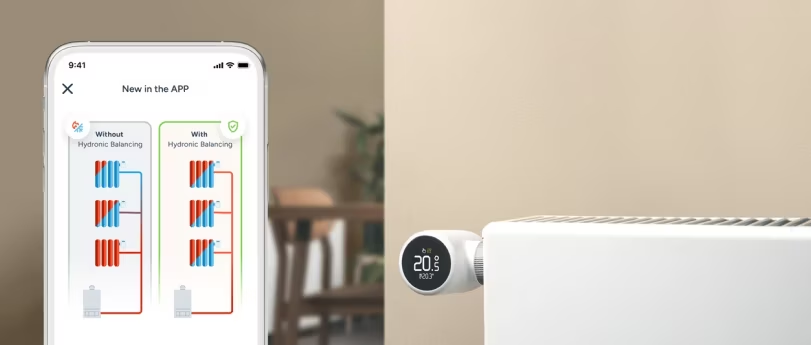
Hydronic balancing: Ensures optimal water distribution and enables lower system temperatures.
Adjust the heating curve: Set the flow temperature as low as possible – just enough to reach the desired room temperature.
Use smart controls: Smart thermostats let you control each room individually. Systems like tado° detect open windows, adapt to your routine and lower the temperature when no one is home.
Increase radiator surface area: Small or poorly positioned radiators need high flow temperatures to heat a room. Replacing them with larger models or low-temperature radiators reduces the flow requirement.
Insulate the building: Every reduction in heating load not only cuts energy consumption – it also allows for lower flow temperatures.
tado° maximises your heat pump efficiency
With the tado° Heat Pump Optimizer X, you can extract an average of 22%¹ more efficiency from your system. Here’s how:
Full control via app
The tado° Heat Pump Optimizer X connects your heat pump to the tado° app – making it smart. Control your heating system from anywhere, track energy consumption in real time, and see exactly how efficiently your rooms and hot water are being heated. DIY installation with the tado° app takes just a few minutes – users rate it 4.6 stars.
tado° Balance
With the tado° Balance subscription, your heat pump automatically runs at the cheapest and most efficient times:
The system factors in variable electricity prices and avoids heating during expensive peak periods.
Got solar panels? Balance shifts heating phases to times when your system is generating electricity – maximising self-consumption.
The system incorporates weather data and schedules heating for the thermodynamically optimal moments.
Compatible with leading brands
The Heat Pump Optimizer X works with many European heat pumps, including Panasonic, Vaillant, Viessmann and others. As an exclusive Panasonic partner for smart heat pump solutions, tado° offers an AQUAREA Sync feature. It prevents excessive cycling and extends the life of your heat pump.
Setup: Panasonic Aquarea heat pump with tado°
Hydronic Balancing via software
Since December 2024, tado° has offered software-based Hydronic Balancing for Smart Radiator Thermostats X. Instead of costly engineer visits and valve replacements, the system learns independently how much flow each radiator needs – and adjusts the valves accordingly.
The benefits:
No installation work required on the heating system
Even heat distribution across all rooms
Optimised efficiency for boilers and heat pumps
Included free of charge for Panasonic Aquarea users with the Heat Pump Optimizer X
Room-by-room control with Smart Thermostats
The Heat Pump Optimizer works seamlessly alongside the tado° Smart Radiator Thermostats X. These measure the actual room temperature and report it back to the Optimizer – enabling demand-led control rather than blanket flow temperatures. The result: the heat pump only runs when heat is genuinely needed.
tado° tip
The combination of Heat Pump Optimizer X, Balance subscription and Smart Radiator Thermostats forms a closed-loop system that intelligently coordinates heat source, distribution and room temperature – for maximum efficiency with minimum effort.
A heat pump with 400% efficiency isn’t a physical impossibility – it’s the result of clever thermodynamics. It harnesses free ambient heat and multiplies the electrical energy put in. The achievable efficiency depends on the heat source, the flow temperature and how the system is controlled. With modern systems and smart controls – such as the tado° Heat Pump Optimizer X – you can get the most from your heat pump and sustainably reduce both heating costs and CO₂ emissions.
¹Based on internal data from average values across all tado° users, collected up to 30.11.23.
FAQs
What SPF is realistic?
For air-to-water heat pumps, SPF values between 3.0 and 4.0 are realistic; for ground source heat pumps, 3.5 to 4.5. With optimal design – such as underfloor heating and a low flow temperature – values above 4.5 are also achievable. A Fraunhofer study shows that even in existing buildings without a full retrofit, strong efficiency figures are possible.
Which heat pump models offer the best efficiency for detached houses?
For detached houses, modern air-to-water heat pumps with R290 refrigerant and inverter technology are recommended. These achieve SCOP values of 4.5–5.5 and run efficiently even at partial load thanks to stepless power adjustment. For those with a higher budget, ground source heat pumps offer the best long-term performance figures.
Can you reduce the energy consumption of an existing heat pump?
Yes – even though the heat pump’s own efficiency rating is fixed, energy consumption can be significantly reduced. Hydraulic balancing ensures all rooms are supplied evenly and the flow temperature doesn’t need to be unnecessarily high. Smart room control – such as the tado° system – reduces heat demand through geofencing, schedules and automatic adaptation to weather data, so the heat pump only runs when heat is actually needed.
How environmentally friendly are heat pumps, really?
According to a Fraunhofer study, the CO₂ emissions of the heat pumps examined in 2024 were 64% lower than those of comparable gas boilers. As the share of renewable energy in the electricity mix increases, this figure will continue to improve.