Electricity prices aren't fixed. They rise and fall throughout the day, driven by supply and demand on the wholesale market. When wind and solar flood the grid with power, prices drop. When demand spikes, they climb. With a dynamic energy tariff and intelligent energy management, you can turn those fluctuations to your advantage – and cut your energy costs by up to 22%.
Read time:
4 mins
Table of contents:
•
Your energy bill is not predictable
Most of us assume electricity has a set price. Well – it doesn't. If you've followed energy news over the past few years, you'll know prices can be highly volatile. They shift seasonally, weekly – sometimes hourly. At first glance, that sounds complicated and rather chaotic. But there's a clear logic behind it: Supply and demand set the price. And once you understand how, you start to see the opportunity.
What actually drives electricity prices?
Electricity is traded on wholesale markets – including exchanges like EPEX Spot, which operates across Europe and Great Britain. For every hour of the coming day, a price is set based on how much electricity is available and how much is needed. When people get home from work in the evening – turning on lights, cooking dinner, running the washing machine – demand rises. So do prices.
When the sun is strong at midday and solar panels are generating at full capacity, or when wind picks up overnight, there's more power in the grid than people are using. Prices fall. Sometimes even dramatically.
In extreme cases, prices can even turn negative. So much renewable energy enters the grid that suppliers effectively pay to have it consumed.
The renewable energy effect
As more wind and solar come online across the UK, these swings are becoming more pronounced. Renewable sources don't follow our daily routines. They follow the weather.
On a stormy night, when most of the country is asleep and demand is low, wind turbines keep spinning. Prices fall. During a grey, still winter week, conventional power stations pick up the slack – and prices rise accordingly. Understanding these patterns means you can shift your consumption to the cheaper hours, which ultimately adds up to significant savings.
Real-life examples
Charging your EV overnight
Most people plug in their electric car the moment they get home. That works just fine, but it's rarely the cheapest time to charge. A much more efficient way is to plug in before bed and let your car charge automatically through the night, when wholesale prices are at their lowest. By morning, the battery is topped up. The miles are the same, but the cost is lower. At weekends, when renewable generation is often high and industrial demand drops, charging costs can fall even further.
Running your heat pump more efficiently
Heat pumps are becoming increasingly common – and for good reason. But left on a standard schedule, they consume energy at the same rate throughout the day, regardless of what electricity costs. A smarter approach is to run your heat pump when electricity is cheapest. The tado° Heat Pump Optimizer X does exactly that. It shifts energy use towards the lower-price hours, so your home stays warm and your bills stay manageable.
Fixed tariff vs. dynamic tariff: what's the difference?
Category
Fixed tariff
Dynamic tariff
Price stability
Consistent
Changes hourly
Savings potential
Limited
High
Flexibility needed
No
Yes
Smart meter required
No
Yes
Best for
Predictability
Smarter consumption
Smart meters: the foundation of it all
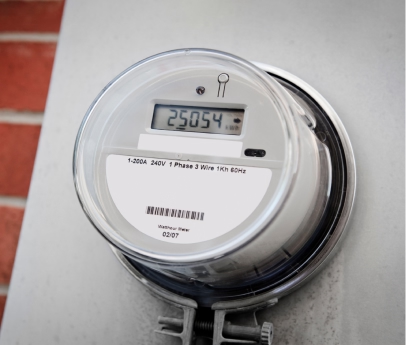
In reality, none of this works without real visibility. A smart meter records your energy use in short intervals and allows accurate billing based on actual hourly prices. In the UK, SMETS2 smart meters are now installed in millions of homes – and if you haven't upgraded yet, it's worth asking your supplier.
Once you have a smart meter, dynamic tariffs become accessible. In the UK, providers like Octopus Energy offer plans – such as Octopus Agile – that pass through real-time wholesale prices directly to you.
Combined with the tado° App and the price data from your dynamic tariff, you can see at a glance when electricity is cheap — and let your devices respond accordingly. tado° Smart Thermostats use that information to heat your home efficiently and keep your bills in check.
A note on tado° energy availability
The tado° Home Hourly tariff and the direct aWATTar integration for fully automated price-optimised heating are currently available in Germany and Austria only. If you're in the UK, keep an eye on tado°'s roadmap!
In the meantime, tado°'s Smart Thermostat and Heat Pump Optimizer X work seamlessly alongside UK dynamic tariffs, helping you reduce waste and cut costs without lifting a finger.
Electricity prices fluctuate because supply and demand constantly shift – and because renewables are an ever-larger part of the grid. This is not going to change. If anything, the swings will get bigger. For households, it’s a huge opportunity. With a smart meter, a dynamic tariff, and the right smart home setup, you can use cheap electricity when it's available – and pay less overall.
FAQs
Why do electricity prices change from hour to hour?
Wholesale electricity prices are set on trading exchanges for each hour of the day, based on real-time supply and demand. High renewable output pushes prices down. High consumption pushes them up.
Can I really save money with a dynamic tariff?
Yes – especially if you can shift flexible loads like EV charging or heat pump operation to cheaper hours. Smart technology like tado° helps automate that shift.
Do I need a smart meter for a dynamic tariff?
Yes. A smart meter measures your consumption in short intervals so your supplier can bill you accurately based on real hourly prices. Most UK suppliers will install one for free.